
Chanel No 19
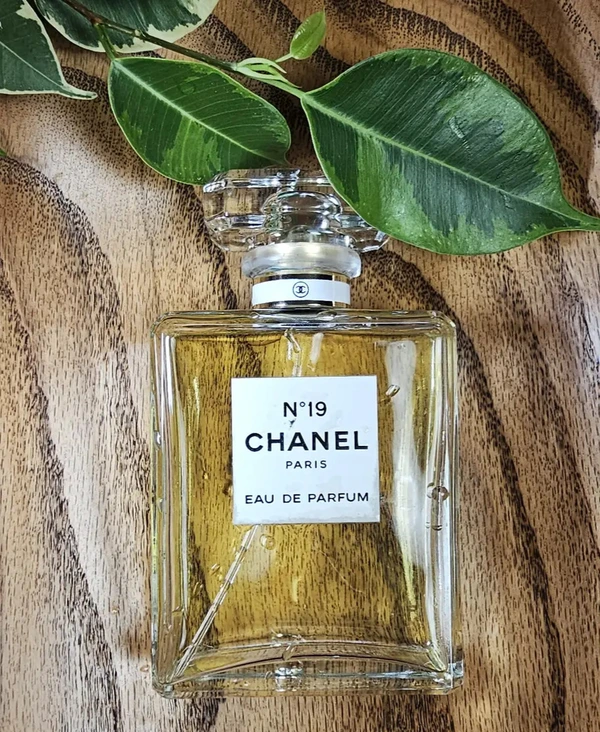
The last fragrance, which Coco Chanel herself approved a few months before her death, was numbered 19, although Chanel initially wanted to call it Coco. It was originally intended for Chanel herself and a small circle of her friends. Her partners were against it, but Chanel insisted. It was only after ordering the labels that she realized the name did not suit the fragrance.
So she named it No. 19. According to numerology, this number, consisting of a one and a nine, connects the first and the last, the beginning and the end, closes the circle and gives perfection and harmony. If you reduce it to a single digit: 1+9=10, 1+0=1, it gives you one, the Sun, a symbol of creativity and innovation. In addition, Chanel was born on 19 August, and apart from directly indicating the number, it also points to the sign of Leo in the horoscope, whose dominant planet is the Sun.
The fragrance came into being thanks to a happy coincidence. This is how Michael Edwards recounts its story in his book Feminine Perfume Legends. Henri Robert, Chanel’s in-house perfumer at the time, worked on the fragrance for quite some time. Mademoiselle constantly rejected the options he proposed. One day, as she was leaving the Ritz, a stranger caught up with her: ‘Excuse me, I’m with two ladies who really like your perfume. Could you tell me whose it is?’ Chanel suggested he walk with her to the boutique at 31 Rue Cambon, where the American understood everything. ‘In their seventies, ladies are rarely asked about their fragrances — that means the fragrance is really good,’ Coco Chanel thought, and decided to release it.
Was the American a wealthy guest at the Ritz Hotel or a decoy sent by Henri Robert and the Wertheimer family?
Fragrance No. 19 became iconic in the early 1970s. It ushered in the second era of green chypres, accompanying the rise of feminism and strong women, businesswomen who wanted to be leaders in their families, the economy and politics. This green chypre was followed by such wonderful green fragrances as Alliage Estee Lauder, Armani (Giorgio Armani), Rive Gauche (YSL), Halston I-12, Inoui (Shiseido), and Silences (Jacomo). Young perfumers are inspired by this legendary fragrance: Papyrus de Ciane (Parfumerie Generale) is a perfect example. Today, this same line is continued by Infusion d’Iris (Prada), a scent (Issey Miyake), (untitled) Maison Martin Margiela, and Le Temps d’Une Fete (Parfums de Nicolai).
In short, the territory once belonging to the Chanel empire has been colonised by dozens of other fragrances, and No. 19, together with the exclusive Bel Respiro Chanel, could not hold on to it. That is why Chanel is soon releasing the fragrance No. 19 Poudre, for young and modern women who do not recognise the authority of the classics.
How does it differ from classic perfumes? The galbanum-neroli-iris-vetiver accord remains, but the accents have changed. ‘I wanted to emphasise the importance of iris for No. 19,’ said Jacques Polge, Chanel’s perfumer, ‘so adding new powdery notes was natural.’ The colour sensation has changed from deep green to a lighter, yellow-green, bright and joyful, like dandelions and grasshoppers, and the mature green has become young, like young birch leaves. Young and green! Galbanum became sunnier thanks to transparent hedione, floral neroli and geranium, starched.
One could also mention the jasmine and rose plantations in Grasse, which Chanel bought to secure its supply of natural raw materials for many years to come. Or the new iris plantations established by Chanel near Grasse four years ago, which will ensure the authenticity and high quality of its absolute, the most expensive of the regularly used perfume ingredients.